


Author: Matthew Wells, DO
Description
Enchondromas are very common, benign (non-cancerous) tumors that form inside bones. They are made up of cartilage — the same smooth material that covers the ends of bones in joints. Doctors often find enchondromas by accident when taking an X-ray for another reason, such as an injury. Most enchondromas occur in the small bones of the hands and feet, but they can also appear in larger bones like the shoulder, thigh, or leg. Usually, enchondromas don’t cause pain or other problems. The main importance of recognizing them correctly is to avoid unnecessary tests or surgeries.
Most enchondromas are solitary (a single lesion), but in rare cases they can be multiple. When multiple enchondromas are present, this may be part of conditions called Ollier disease or Maffucci syndrome. In very rare cases (less than 1 in 100), an enchondroma can grow unusually large or transform into a malignant tumor called chondrosarcoma.
Symptoms
Most enchondromas are small (smaller than 5 cm), stay inside the bone, and don’t cause any pain. If someone feels pain near an enchondroma, it’s usually from something else—like a torn muscle or joint problem. For example, a 60-year-old man who works with his hands might have shoulder pain because of a rotator cuff tear, not because of the enchondroma seen in an X-ray. Sometimes, an enchondroma can cause mild pain, or a visible bump if it grows near the surface of the bone. In the small bones of the hand or foot, it may weaken the bone, increasing the risk of a fracture (break) even after a minor injury.
Examination
During a physical exam, the doctor will look for any tenderness or deformity in the affected area. In most cases, there are no obvious findings, especially if the enchondroma is deep inside the bone. If the tumor has caused a fracture or is pressing on nearby structures, there may be pain or limited movement in the nearby joint. If the enchondroma is in the hand or foot, a doctor might feel a small bump on the bone. But most of the time, you can’t see or feel anything. Most enchondromas do not cause pain and are not noticeable.
Tests
Doctors usually find enchondromas by taking an X-ray of the area. Most of the time, that’s all they need to do. If the enchondroma looks different, is larger than usual, or the doctor is worried it might be more serious, they may order more advanced imaging like a CT scan or MRI. If the doctor thinks it could be cancer (which is very rare), they may send you to a special bone doctor called an Orthopedic Oncologist for assessment, and possibly a biopsy (a test where they take a tiny piece of tissue for testing).
Images
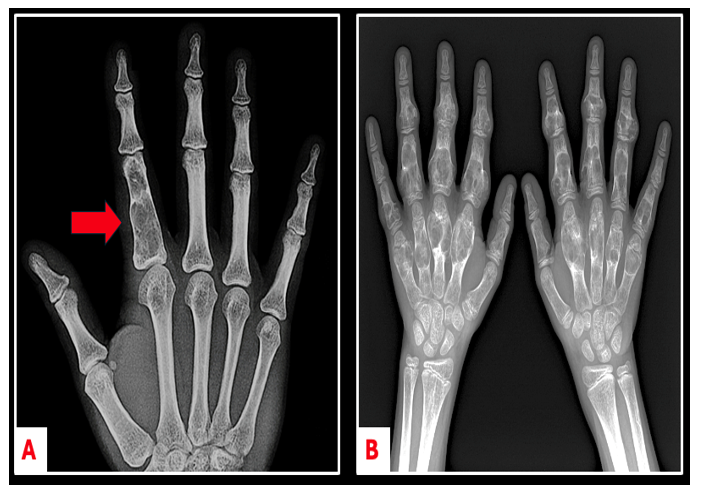
On an X-ray, enchondromas look like an area with white, popcorn-like spots in the middle of the bone (Figure 1). In small bones like the fingers and toes, the bone around the bump may look a little wider or expanded (Figure 2A).
Very rarely, the enchondroma may:
- Grow larger than 5 cm
- Wear down the bone from the inside out
- Spread into soft tissue nearby
There is a rare condition called Ollier disease (also known as enchondromatosis) in which people develop multiple enchondromas in different parts of their body (Figure 2B). Ollier disease occurs in about 1 out of every 100,000 people. A related condition, called Maffucci syndrome, also causes multiple enchondromas but includes benign blood vessel growths (called hemangiomas) in the skin or soft tissues. People with Ollier disease or Maffucci syndrome should see an Orthopedic Oncologist for regular check-ups, since they have a higher risk of developing a chondrosarcoma (a type of bone cancer). Most people, however, have just one enchondroma, and in those cases, the chance of it turning into cancer is very rare. These patients usually don’t need frequent check-ups or treatment.
Figure 1. Anterior-posterior (AP) imaging of an enchondroma in the proximal humerus (A) and in the distal femur (B).
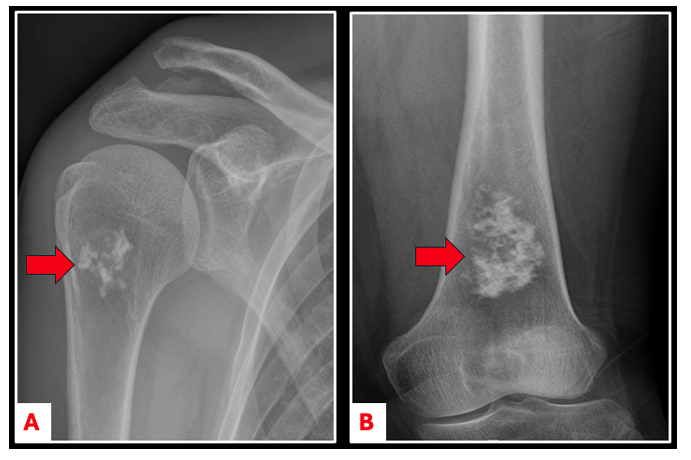
Figure 2. Anterior-posterior (AP) imaging comparing a simple enchondroma of the hand (A) versus the numerous enchondromas found in Ollier Disease (i.e. enchondromatosis, B).
Prognosis
Enchondromas usually have an excellent outcome. Most people don’t even know they have one, since these tumors are small, painless, and noncancerous. Surgery is rarely needed—only if the enchondroma causes pain, weakens the bone, or affects daily activities. In those uncommon cases, the surgeon can remove the tumor by scraping it out (a procedure called curettage) and then filling the space with bone graft. Depending on the size and location, the surgeon may also use plates or screws to help stabilize the bone while it heals.
There is a very small chance (less than 1 in 100) that an enchondroma could turn into cancer later in life. People with Ollier disease or Maffucci syndrome have a higher risk of this happening. Because of this, it’s best for these patients to be followed by an Orthopedic Oncologist—a specialist in bone and soft tissue tumors—to ensure they receive the right care and monitoring over time.
More Information:
This is not intended as a substitute for professional medical advice and does not provide advice on treatments or conditions for individual patients. All health and treatment decisions must be made in consultation with your physician(s), utilizing your specific medical information. Inclusion in this is not a recommendation of any product, treatment, physician or hospital.